
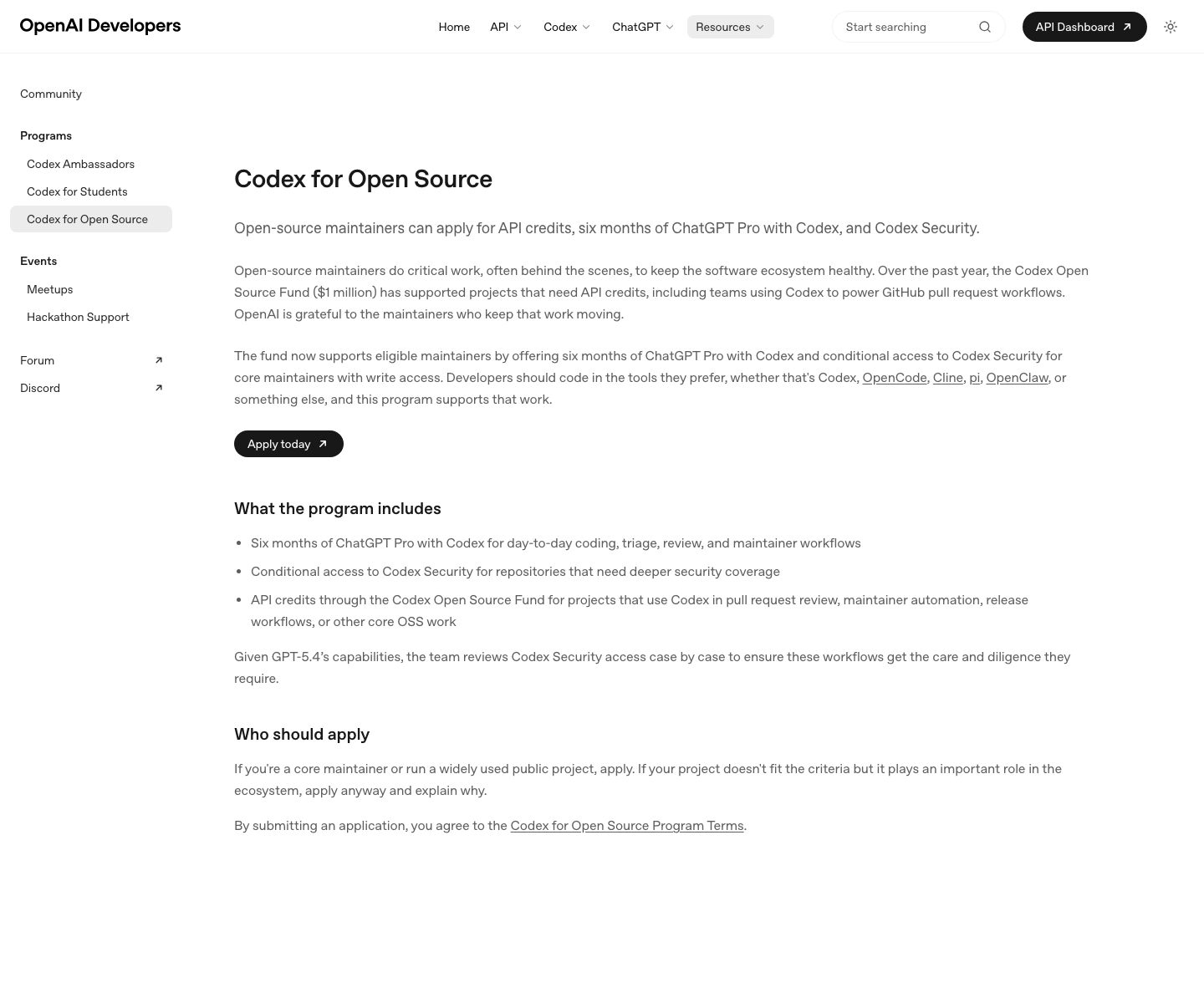
Many people search for “how to use ChatGPT for free.” A more accurate version of that question is: how can eligible open-source maintainers apply for official ChatGPT Pro benefits through an OpenAI program?
ChatGPT already has a free tier. If you are not maintaining an open-source project, this is not a general “free Pro giveaway” guide.
But if you are an open-source maintainer, OpenAI’s Codex for Open Source program gives you an official path to apply. According to OpenAI’s official page, maintainers can apply for API credits, six months of ChatGPT Pro with Codex, and conditional access to Codex Security.
This article is based on the OpenAI pages available on May 7, 2026. Program rules and forms may change, so check the official pages before applying.
One-line Summary
Codex for Open Source is not a free ChatGPT Pro campaign for everyone. It is an OpenAI support program for open-source maintainers.
If you maintain a public open-source project and can clearly explain the project’s value, your maintainer role, and how AI tools will support real maintenance work, it is worth applying.
What Is Codex for Open Source?
Codex for Open Source is an OpenAI program designed to support maintainers behind important open-source software.
OpenAI describes open-source maintainers as people who often carry significant responsibility behind the scenes: reviewing pull requests, triaging issues, maintaining releases, and preserving security and code quality. The program is meant to reduce coding and review load with tools built for real maintenance workflows.
The official page currently lists these possible benefits:
| Benefit | Best suited for |
|---|---|
| Six months of ChatGPT Pro with Codex | Day-to-day coding, code understanding, issue analysis, PR review, documentation, and maintainer workflows |
| API credits | PR review automation, maintainer automation, release workflows, and open-source project bots |
| Codex Security | Deeper security-related analysis for eligible repositories |
These benefits are not guaranteed. OpenAI’s program terms say approved applicants may receive one or more benefits, as determined by OpenAI. Availability, duration, scope, and timing may vary by applicant, repository, or use case.
Who Should Apply?
The program is mainly for the following groups.
1. Primary or Core Maintainers
If you are the primary maintainer or a core maintainer of an open-source project, and you regularly handle issues, pull requests, releases, security fixes, documentation, tests, or community maintenance, you are a strong fit.
The application form asks you to describe your role, so be specific. Do not just say you are a user or a fan of the project. Explain what maintenance responsibilities you actually hold.
2. Maintainers of Public Projects with Real Usage
The official page encourages core maintainers or people who run widely used public projects to apply.
That does not mean only projects with huge star counts are eligible. If your project plays an important role in a language ecosystem, framework ecosystem, plugin ecosystem, infrastructure layer, or developer tooling workflow, explain why it matters.
Useful proof points include:
- GitHub stars, forks, and contributors
- npm, PyPI, Maven, crates.io, Docker Hub, or other package download numbers
- downstream dependencies, user stories, or production usage
- PR, issue, and release activity over the last three to six months
- your own work on review, triage, releases, security fixes, or documentation
3. Maintainers with a Clear AI Workflow
Your application will be more convincing if you can describe how Codex or API credits will be used in open-source maintenance.
Good examples include:
- first-pass pull request review
- change summaries
- test suggestions
- release note generation
- maintainer scripts
- issue classification and triage
A strong application should not simply say, “I want free ChatGPT Pro.” It should explain:
- why the project deserves support
- what maintenance role you hold
- how ChatGPT Pro, Codex, or API credits will help with open-source work
- how maintainers will review AI output before acting on it
What Should You Prepare Before Applying?
The official OpenAI application form currently asks for the following information:
| Field | Notes |
|---|---|
| First name / Last name | Your name |
| The email associated with your ChatGPT account | |
| GitHub username | Your GitHub profile visibility should be public |
| GitHub repository URL | The repository should be public |
| Maintainer role | Whether you are a primary maintainer or core maintainer |
| Why does this repository qualify? | Include GitHub stars, monthly downloads, or ecosystem importance, within 500 characters |
| I’m interested in | Codex Security and/or API credits |
| OpenAI Organization ID | The form provides a link to find it |
| How will you use API credits for your project? | Explain how credits will support project maintenance, within 500 characters |
| Anything else we should know? | Additional project context or maintainer workload, within 500 characters |
The form also says OpenAI reviews applications on a rolling basis and notifies selected applicants by email.
Step-by-step Application Guide
Step 1: Confirm That You Fit the Program
First, check whether you are truly maintaining an open-source project.
Do not create an empty repository just to apply. Do not exaggerate your project’s impact. OpenAI’s program terms require applicants to provide accurate and complete information about themselves, their repositories, and their maintainer or administrator role.
OpenAI may consider repository usage, ecosystem importance, evidence of active maintenance, role or permissions, and program capacity.
In short: submitting an application does not guarantee ChatGPT Pro, API credits, or Codex Security access.
Step 2: Prepare Evidence of Project Impact
Prepare a short explanation of why your repository qualifies. The form limits this field to 500 characters, so make every sentence concrete.
You can use this structure:
I am the core maintainer of [project], responsible for PR review, issue triage, releases, and security fixes. The project has [stars/downloads/users] and is used by [ecosystem/users/downstream projects]. It plays an important role in [specific ecosystem or scenario].If your project has a smaller GitHub footprint but matters in a specific ecosystem, say that clearly. For example, it may be a framework plugin, deployment tool, SDK, MCP server, CLI tool, language ecosystem component, or a dependency used by real downstream projects.
Step 3: Open the Official Application Page
Go to the official Codex for Open Source page, then click Apply today to open the OpenAI application form.
The form currently says selected maintainers may receive:
- 6 months of ChatGPT Pro, which includes Codex
- Conditional access to Codex Security
- API credits for coding, maintainer automation, release workflows, and core open-source work
Step 4: Write the Two Most Important Answers
The most important parts of the form are the two short text fields.
The first is Why does this repository qualify?
This should explain why your repository deserves support.
Example:
I am the primary maintainer of [project], responsible for PR review, issue triage, releases, and documentation. The project has [stars] GitHub stars and about [downloads] monthly downloads. It is used by [downstream projects/users] and provides [specific value] for the [ecosystem] ecosystem.The second is How will you use API credits for your project?
This should explain how credits will be used for open-source maintenance.
Example:
We plan to use API credits for pull request review, change summaries, test suggestions, release note generation, issue triage, and maintainer automation. All outputs will be reviewed by maintainers and used only for authorized repositories and core open-source maintenance workflows.Keep the use case tied to open-source maintenance. Do not describe personal experiments, unrelated commercial projects, or unrestricted sharing with a team.
Step 5: Submit and Wait for Email
After submission, wait for OpenAI’s review.
The form says applications are reviewed on a rolling basis and selected applicants are notified by email. OpenAI’s terms also say it may approve or deny applications at its discretion, and may request additional information to verify identity, repository affiliation, maintainer status, or repository control.
How to Improve Your Application
Do Not Lead with “I Want Free ChatGPT”
The program is about open-source maintenance, not personal free access.
A stronger angle is: you want to use ChatGPT Pro with Codex to reduce maintainer workload and improve PR review, bug triage, release, documentation, and testing workflows.
Make Project Impact Specific
This is more convincing:
The project has 2,000 GitHub stars, 50,000 monthly npm downloads, and is used by several downstream developer tools.If you do not have package download numbers, use activity, downstream usage, community examples, or ecosystem role.
Make Your Maintainer Role Clear
The form asks for your GitHub profile and repository to be public. Your text should also make your role obvious.
Examples of concrete responsibilities:
- reviewing pull requests
- triaging issues
- maintaining releases
- fixing security issues
- maintaining documentation
- managing CI or release workflows
Keep API Credit Usage Compliant
Avoid writing:
I want to use the credits for my personal AI experiments.Write something closer to:
We will use API credits for PR review summaries, test suggestions, release note generation, and issue triage. Maintainers will review all AI outputs before taking action.Important Caveats
1. Applying Does Not Guarantee Approval
OpenAI’s program terms are clear: submitting an application does not guarantee selection, funding, or access.
OpenAI may consider repository usage, ecosystem importance, evidence of active maintenance, maintainer role or permissions, and program capacity.
2. Benefits Are Not Transferable
Program benefits are personal, limited, non-transferable, and have no cash value. They may not be sold, assigned, sublicensed, exchanged, or shared.
If OpenAI provides a redemption code, invitation, or activation flow, the recipient must follow the applicable redemption instructions and any additional terms.
3. Codex Security and API Credits May Require Extra Review
Codex Security and API credits are optional additional benefits. They may require separate review, additional eligibility checks, or additional terms.
For Codex Security especially, OpenAI may limit access to repositories that the applicant owns, maintains, or is otherwise authorized to administer.
4. Do Not Review Unauthorized Repositories
OpenAI’s terms also restrict use of the program, including Codex Security, for repositories, systems, or codebases that you do not own or lack permission to review.
If authorization is unclear, OpenAI may require proof of control or authorization, and may limit or revoke access.
Copy-ready Application Templates
Repository Qualification Template
I am the core maintainer of [project name], responsible for PR review, issue triage, releases, documentation, and security fixes. The project has [stars/downloads/users] and is used by [ecosystem/users/downstream projects]. It plays an important role in [specific ecosystem or scenario], and ChatGPT Pro with Codex would help reduce review workload and maintain code quality.API Credits Usage Template
We plan to use API credits for pull request review, change summaries, test suggestions, release note generation, issue triage, and maintainer automation. All outputs will be reviewed by maintainers before use, and credits will only be used for authorized repositories and core open-source maintenance workflows.Conclusion
Applying for ChatGPT Pro through Codex for Open Source is not about exploiting a free offer. It is about OpenAI supporting real open-source maintenance work.
If you maintain a public open-source project and can clearly explain its value, your role, and how AI tools will improve your maintenance workflow, the program is worth a serious application.
For maintainers, the most valuable part is not only six months of ChatGPT Pro. It is the chance to connect Codex, API credits, and security tooling to real workflows: faster PR review, better issue triage, easier release notes, and more time for architecture, quality, and community decisions.