
AI-generated images are becoming more realistic, easier to share, and easier to edit. That creates a practical problem: when an image appears on a social platform, in a news context, or in a group chat, it is often hard to tell whether it came from a camera, design software, or an AI tool.
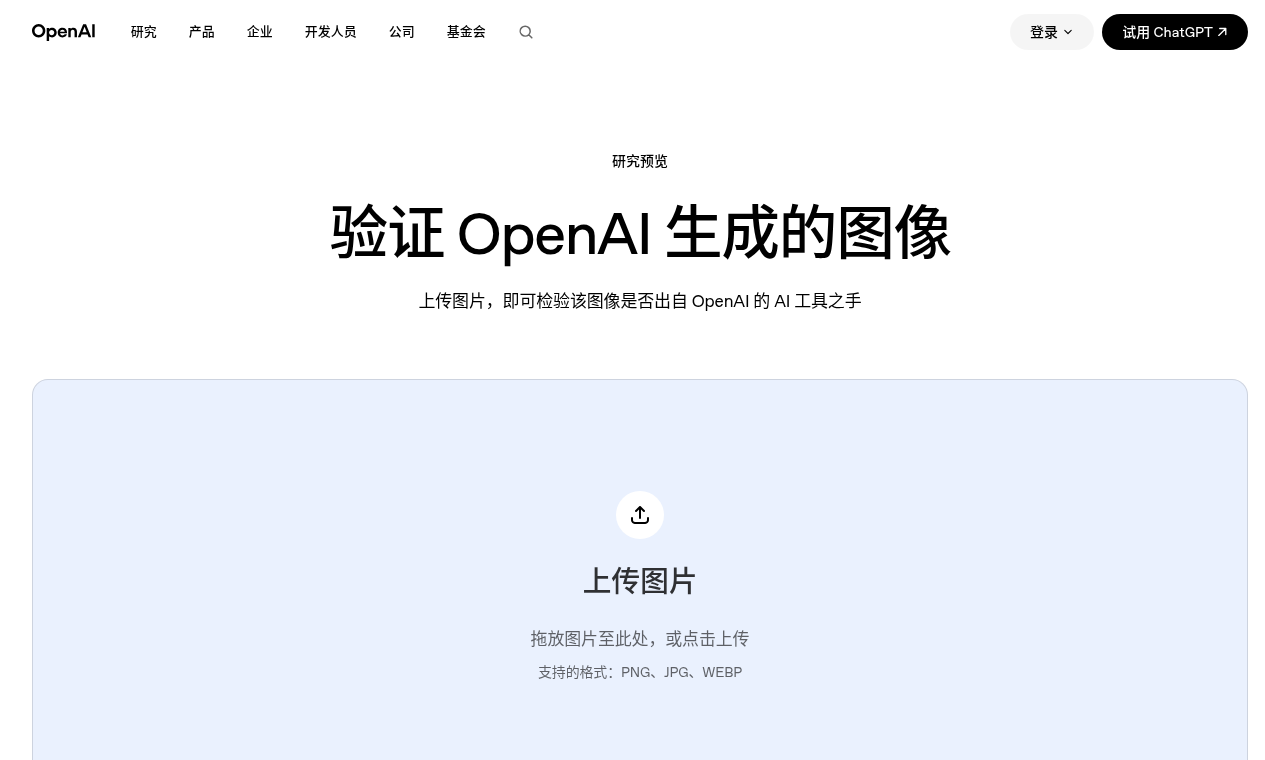
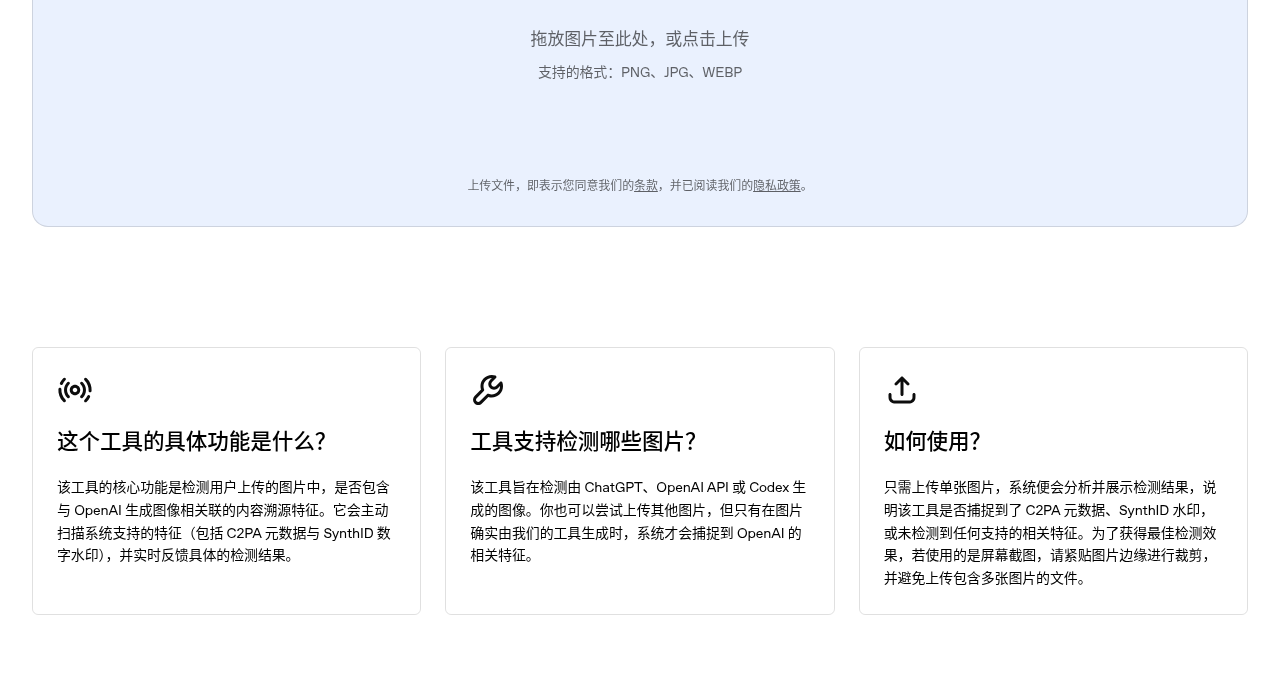
OpenAI’s “Verify OpenAI-generated images” tool is built for this problem. You upload an image, and the system checks whether it contains provenance signals associated with OpenAI-generated images. In other words, it helps determine whether the image may have been created by tools such as ChatGPT, the OpenAI API, or Codex.
This is not a tool for detecting fake news, and it does not decide whether the content of an image is true. It is closer to a source checker: it looks for technical traces that indicate whether the image came from OpenAI’s image generation systems.
What does it do?
The workflow is simple: upload a PNG, JPG, or WEBP image, and the tool analyzes it and returns a detection result.
It mainly looks for two kinds of signals:
- C2PA content credentials
- SynthID digital watermarks
If these signals are present, the tool can indicate that the image was likely generated by an OpenAI tool.
The key idea is provenance, not truth verification. For example, if an AI-generated image claims to show a flood in a certain city, a successful detection result can only tell you that the image came from an OpenAI tool. It cannot tell you whether the event actually happened, whether the location is correct, or whether the image is being used in a misleading context.
So the tool answers this question:
Was this image generated by an OpenAI tool?
It does not answer this one:
Is the claim made by this image true?
What are C2PA and SynthID?
OpenAI’s verification tool relies on two different technical approaches.
The first is C2PA content credentials.
C2PA can be understood as source information embedded into digital media metadata. For supported OpenAI-generated images, the credential can show that the image was created by tools such as ChatGPT or the API. As long as the credential remains intact, it is a strong provenance signal.
But it has a limitation: it depends on metadata. After an image is shared, compressed, screenshotted, or edited, that metadata may be removed. Once it is stripped away, the tool may no longer detect it.
The second is SynthID digital watermarking.
SynthID is a more invisible watermarking technique. Instead of placing a visible mark in a corner of the image, it embeds signals directly into the image content. This makes the signal more resilient to operations such as cropping, filters, and lossy compression.
In simple terms:
- C2PA is more like an ID card inside the image file
- SynthID is more like an invisible mark embedded in the image itself
Together, they improve the reliability of AI image provenance checks.
What does a positive result mean?
If the tool detects relevant signals, the image was very likely generated by an OpenAI tool.
OpenAI also notes that these detections are highly reliable and have very few false positives. So when the tool clearly finds OpenAI-related provenance signals, it should be treated as a strong indication of origin.
But there is still an important boundary: the result does not tell you what happened to the image after it was created.
For example, it does not prove whether the image was:
- cropped
- recompressed
- annotated with text
- used in the wrong context
- combined with other images
- otherwise edited after generation
So a positive result supports the image’s likely origin, but it does not verify the surrounding context.
What if nothing is detected?
This is the part most likely to be misunderstood.
If the tool does not detect any supported signals, it does not mean the image was definitely not generated by OpenAI.
Possible reasons include:
- the image metadata was removed
- the digital watermark was damaged or degraded
- the image was screenshotted, compressed, or edited
- the image was generated by an older OpenAI image model
- the image was created before the relevant provenance features were introduced
- the image may have been generated by another company’s AI model
So “not detected” only means that the uploaded image does not contain the OpenAI provenance signals currently supported by this tool.
It does not prove that the image is not AI-generated. It also does not prove that the image is real.
That distinction matters.
Why does this tool matter?
AI images can spread quickly across the internet, especially around news events, public safety topics, social controversies, and marketing campaigns. A single image can easily be separated from its original context.
Content provenance gives people one more signal to work with.
When you see an image, knowing whether it was generated by an AI tool can help you decide more carefully whether to:
- trust it
- share it
- treat it as evidence
- look for additional context
For media organizations, platforms, researchers, creators, and everyday users, tools like this can reduce the chance of misreading online media.
It does not solve every problem, but it makes the question “where did this image come from?” more transparent.
What should you pay attention to when using it?
OpenAI recommends uploading a single image for analysis. If you are using a screenshot, crop it closely around the image and avoid uploading a file that contains multiple images.
That helps reduce noise and gives the system a better chance of detecting C2PA metadata or SynthID watermarks.
OpenAI also states that uploaded images are processed to detect provenance signals associated with OpenAI-generated content. Unless required by law, uploaded images are not stored and are not used to train OpenAI’s models.
What does this really change?
In the past, people often relied on visual inspection to judge whether an image might be AI-generated: lighting, fingers, text, texture, or small visual artifacts. But as image generation improves, visual inspection becomes less reliable.
OpenAI’s verification tool points to a different direction: instead of only asking whether an image “looks real,” we can ask whether it carries trustworthy technical source information.
That is more robust than pure visual guessing, and it fits better with the future of online media.
Of course, it is not a universal answer. It only covers supported OpenAI-generated images, it cannot identify every image generated by every AI model, and it cannot judge whether the message conveyed by an image is true.
But it offers a clear direction: AI content should not only be generated; it should also be traceable, explainable, and verifiable.
As AI-generated content becomes more common, transparency itself becomes part of the infrastructure. OpenAI’s image verification tool is one piece of that infrastructure.